Flag of Earth

Flag of Earth
NEW Earth Flag

Is There LIFE on Planet GJ581g?

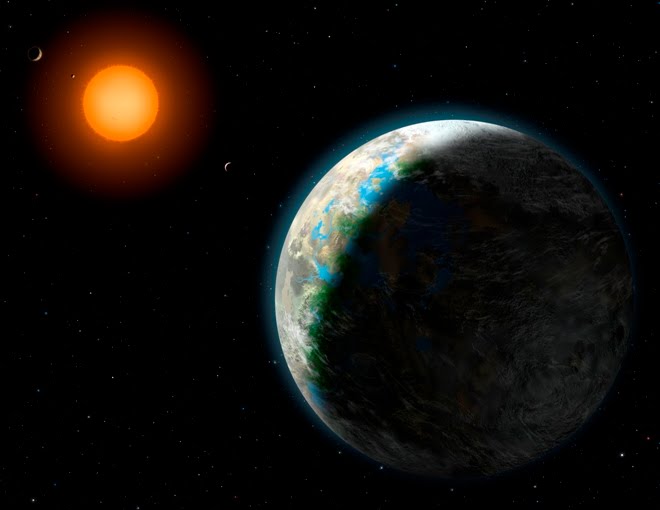
GJ 581 g is an Earth-like planet recently discovered orbiting Gliese 581, a red dwarf star categorized as M Dwarf. This new discovery is perceived by scientists as as a Goldilocks type sphere - not too hot, not too cold. Nicknamed Zarminas World (after his wife Zarmina) by project leader Steven S Vogt, GJ581g will fascinate and enthrall Earthlings for generations to come.

GJ581G Orbiting Gliese 581

GJ581G Orbiting Gliese 581
Earth Has A Twin

Solar Powered System

Solar Powered System

Astronomy News Info Photos Telescopes

Chitika Network Links

Astronomy For Everyone

Green Mutual Fund Investing Info

Popular Posts

astronomycentral.co.uk

Best Green Stocks Investing Blog

NASA Watch

Showing posts with label 2012 prophecies. Show all posts

Wednesday, June 22, 2011

348 days to 2012 Transit of Venus


Did Mayans feel 13th pair of Venus Transits would be catastrophic?


The next Transit of Venus will occur on June 5–June 6 in 2012, succeeding the previous transit on June 8, 2004. After 2012, the next transits of Venus will be in December 2117 and December 2125. Transits of Venus are among the rarest of predictable astronomical phenomena and currently occur in a pattern that repeats every 243 years, with pairs of transits eight years apart separated by long gaps of 121.5 years and 105.5 years.

As there have been 13 pairs of the Transit of Venus since the last major climactic calamity on Earth, that's a cycle of 3,159 years (13 times 243), which takes us back to around 1150BCE.


Wikipedia pins Bronze Age collapse to 1150-1200BCE

The Bronze Age collapse is a transition in southwestern Asia and the Eastern Mediterranean from the Late Bronze Age to the Early Iron Age that some historians believe was violent, sudden and culturally disruptive. The palace economies of the Aegean and Anatolia which characterised the Late Bronze Age were replaced, after a hiatus, by the isolated village cultures of the Ancient Dark Age.

Between 1206 and 1150 BCE, the cultural collapse of the Mycenaean kingdoms, the Hittite Empire in Anatolia and Syria,[1] and the Egyptian Empire in Syria and Canaan interrupted trade routes and severely reduced literacy. In the first phase of this period, almost every city between Troy and Gaza was violently destroyed, and often left unoccupied thereafter: examples include Hattusa, Mycenae, Ugarit.

The gradual end of the Dark Age that ensued saw the rise of settled Neo-Hittite Aramaean kingdoms of the mid-10th century BCE and the Neo-Assyrian Empire.


Wikipedia info on 2012 Transit of Venus


Above Top Secret 2012 Transit of Venus webpage

Monday, May 9, 2011

Yu55 asteroid to pass near earth just before 2012 begins


Flyby within 200,000 miles of Earth, or 1 Light-second


According to Space.com (May 8th, 2011), An asteroid the size of an aircraft carrier will come closer to Earth this autumn than our own moon does, causing scientists to hold their breath as it zooms by. But they'll be nervous with excitement, not with worry about a possible disaster.

There's no danger of an impact when the asteroid 2005 YU55 makes its close flyby Nov. 8, coming within 201,700 miles (325,000 kilometers) of Earth, scientists say.

So they're looking forward to the encounter, which could help them learn more about big space rocks.

"While near-Earth objects of this size have flown within a lunar distance in the past, we did not have the foreknowledge and technology to take advantage of the opportunity," Barbara Wilson, a scientist at NASA's Jet Propulsion Laboratory in Pasadena, Calif., said in a statement. "When it flies past, it should be a great opportunity for science instruments on the ground to get a good look." [Photos: Asteroids in Deep Space]

Getting to know YU55

Asteroid 2005 YU55 is about 1,300 feet (400 meters) wide. It was discovered in December 2005 by the Spacewatch program at the University of Arizona in Tucson.

Because of the asteroid’s size and orbital characteristics, astronomers have flagged 2005 YU55 as potentially dangerous down the road. But the upcoming encounter is no cause for alarm, researchers said.

"YU55 poses no threat of an Earth collision over, at the very least, the next 100 years," said Don Yeomans, manager of NASA's Near-Earth Object Program Office at JPL. "During its closest approach, its gravitational effect on the Earth will be so minuscule as to be immeasurable. It will not affect the tides or anything else."

This round space rock has been in astronomers' cross hairs before. In April 2010, astronomers at the National Science Foundation's Arecibo Observatory in Puerto Rico generated some ghostly radar images of 2005 YU55 when the asteroid was about 1.5 million miles (2.3 million km) from Earth.

But those pictures had a resolution of just 25 feet (7.5 meters) per pixel. The November close pass should provide some sharper images.

"When 2005 YU55 returns this fall, we intend to image it at 4-meter resolution [13 feet] with our recently upgraded equipment at the Deep Space Network at Goldstone, California," said JPL radar astronomer Lance Benner. "Plus, the asteroid will be seven times closer. We're expecting some very detailed radar images."


Space.com article about Yu55 asteroid that will pass close to Earth

Sunday, January 16, 2011

Astronomical origins of Maya Calendar 2012 prophecies

To me it seems likely that the Transit of Venus in 2012 is the most obvious reason the Mayan priests would define 2012 as the end of one era. December 21, 2012 is the date of the Winter Solstice, the lowest point of the Sun in the sky, and thus the darkest day in the final year of the Mayan Calendar. Let's hope it truly is darkest right before the Dawn...

What remains much more puzzling is the reason for the beginning date of the Mayan Long Count Calendar, which occurs 5,125 years before the calendar's end, and about 2,500 years before the calendar's creation. There must have been legends about what happens when certain astronomical patterns appear, and studying the sky revealed the length of the cycle and where we are in it.

According to an article entitled 2012: End of the Fifth Sun by Will Hart, the Mayan Long Count Calendar begins with the "Birth of Venus."

The Maya conceived of time and human history as moving in cycles, small and large. While we use a single calendar to keep track of our annual solar circuit and to mark all of the important days within a year, the Maya used a variety of calendars. The array included a 365-day solar calendar; a 260-day sacred calendar and a Long Count calendar that operated something like an odometer with a zero start date. Unlike the other calendars the Long Count clocked linear time and was programmed to stop after 5,125 years elapsed.

The Long Count was begun at the onset of this current cycle, known as the 5th Sun, in 3114 BC. It will clock the required number of years to complete a full cycle of five suns on December 21, 2012. John Major Jenkins has made the case that this date corresponds to two major alignments, (one between the winter solstice sun and the galactic equator; the other an approximate one between solstice sun and galactic core) and it also completes the Great Zodiac precession cycle of 26,000 years. I am not questioning this thesis however I do wonder if that is all there is to the end of this solar cycle- the 5th Sun?

The Maya began their Long Count on what they referred to as the ‘Birth of Venus.’ Scholars have never been able to determine what the Maya were referring to and neither have alternative researchers. Nevertheless their sacred calendar, the Tzolkin, placed the synodic cycles of Venus in a central role. The 104-year ‘Venus Round’ cycle (2 Calendar Rounds of 52 years each), was a very important ceremonial event as this was the point in time when the solar and sacred calendars realigned with the cycle of Venus.

I need to insert an important numerical progression at this point to provide a basis for the rest of the article. The number thirteen was a root number for the Maya. It is both a prime number and the eighth number in the crucial Fibonacci series that is one source of the Golden Ratio, 1.618.

If we use 13 as the root of the Mayan calendar system we find the following sequence: 13, 26, 39, 52, 65, 78, 91 and 104, which are achieved by simply adding 13 to each succeeding sum. These are the key numbers in the Mayan calendrics and they have a solid scientific footing. Venus was the central component of the Mayan cosmology. It is for good reason that our nearest planetary neighbor is called earth’s sister planet. They have a phase-locked orbital cycle that is based on a 13:8 ratio. That is derived from the fact that Venus revolves around the sun 1.6 times faster than Earth so that 13 Venus revolutions is equal to 8 years.

Why is this important? By establishing Venus as the key component of the sacred calendar they automatically built the Golden Ratio (1.6) into the system since that ratio defines the difference between the two planets orbital cycles. By using 13 as the root number they also included the crucial multiples, or powers, of thirteen - 13,000 and 26,000 - or half as well as the full number of years in the precession. We see that the 5 Suns, each lasting 5,125 years, also add up to the Great Zodiacal Year.
We can break these numbers down in different ways and each will show that there was nothing arbitrary about the Mayan system. We somewhat arrogantly disdain other cultures for being superstitious until we come to the number 13 and our own irrationality surfaces. But let’s examine how deeply embedded this number - as well as 26, 52 and 91 - are in our own calendar. Our year is divided into four seasons that are demarcated by the equinoxes and solstices.

Each of the four seasons is 91 days or 13 weeks long, which gives us a year of 52 weeks. We see the key Maya 13-base numerical progression reflected in our own calendar. Half of a year is 26 weeks. It is beyond the scope of this article to delve into all of the intricacies of the Mayan calendrical and mathematical systems; they were extremely adept in these fields.

What I have uncovered during my decades of research into this topic are two crucial keys to understanding the system: the ‘Transit of Venus’ and solar output cycles. It just so happens that the 2012 end date corresponds to a Venus Transit cycle that occurs twice in the next 10 years in 2004 and then in 2012. As mentioned above Venus was central to the Mayan cosmology. The Long Count began on what the Maya call the “Birth of Venus” so it is perhaps not too surprising that it ends on a Transit of Venus.


Full online article 2012: End of the Fifth Sun by Will Hart


Here is another explanation of the reason for the origin date (interesting to note that the author of the italicized text below, Carl Johann Calleman, believes the end of this creation cycle is October 28, 2011):

The exact Long Count beginning date ultimately is calibrated based on the date of solar zenith in Izapa, which occurs on August 12. (Izapa is the ancient Mayan site in southern Mexico where the Long Count was first devised.)

This solar zenith day was since long, long before the Long Count was implemented, considered as the day of the year when “time began” and considered as a holy date in the location of Izapa. There is thus every reason to believe that the solar zenith was the reason the initial day in the Long Count, 4 Ahau 8 Cumku, was set on this day, although obviously the date of solar zenith in Izapa has nothing to do with the real beginning of the corresponding divine creation cycle. (Not to use the solar zenith date as the beginning of the Long Count would have been considered as heresy. We may make the comparison with the date of Christmas, which was taken from old solstice celebrations, and has not been changed, despite the fact that few, if any, believes that Jesus was born then).


If Calleman is correct about the reason for August 12, 3114 BC, being chosen as the commencement date for the Maya Calendar, then that puts even more emphasis on the end date being related to the upcoming 2012 Transit of Venus.

As the commencement date of the Maya Long Count Calendar is most often pegged as 3,114 BC, it is instructive to see if there were any Transits of Venus or other significant astronomical events during that year or shortly thereafter.

It turns out there were Transits of Venus in 3108 BC and 3100 BC (see historical dates of Transits of Venus), so this particular transit pair may have been perceived as the end of the era that took place before the one we are living in.

Here's a comment (from someone named Anonymous Coward...) about what happened to the Earth's climate around that time, through analysis of Indus Valley:

First I have made a time calibration: 3500 BP radiocarbon calibrated as 2200 BC, 4300 BP radiocarbon calibrated as 3100 BC (based on Schove: Sunspots plus several articles in Nature). Place: near the mouth of Kalinadi river.

Evergreen forest dropped from nearly 30% from 3100 BC to 15-20% in 2800 BC. The next drop was from nearly 20% in 2200 BC to below 10% in the next centuries. At the same time periods savanna increased from 20% to 40%, then remained at that level until 2200 BC, when there began a rapid increase, which leveled at 60% in 2 centuries. The most dramatic shifts are seen in delta(13)C: A sudden change from the level of 23 o/oo to 23.5 in 3100 BC and a rapid return to 23, and a new sudden change to 23.5 at 2200 BC and then a sharp change that eventually levels off to today´s value of 21.5 o/oo some thousand years later.


Source: GodlikeProductions.com post regarding ancient climate catastrophes


2012 prophecy and Mayan Calendar links

Transits of Venus dates from 5000 BC / BCE to 10,000 AD / CE

Worldwide climate catastrophe circa 3123 bc

Meteorites and the Mayan Long Count Calendar

GJ581g Zarminas World Info and Links

Search Green Stocks Investing Network

Custom Search

21st Century Architecture

PV Intell Photovoltaic Solar Stocks Investing

Exoplanetology

Slacker Astronomy

CosmoBC.com AstroBlog

GreenDemocraticParty.ca

Universe Today

Yuya Joe Culture Blog