Twin Suns and Exoplanets, a rockin' week!
This corner of Our Universe is filled with delight this week by the news of a planet orbiting two suns, and so many newly-discovered exoplanets are surely cream cheese icing on this pineapple-walnut carrot cake. From an excellent report by Rob Simpson on Astronomy Blog:
Over the past week we've had a slew of planet announcements including: 50 candidates discovered with HARPS (on the VLT) on Monday; 23 discovered with WASP on Tuesday; and another 7 announced since yesterday. The discoveries this week have been due to astronomers saving up announcements for the Extreme Solar Systems conference in Wyoming. They've taken the total number of exoplanet candidates up to 684! Will we reach 1000 by the end of the year?
This new system is remarkable because it is the first planet found to orbit a double star system. This is really helpful because it provides many different types of transits (each of the stars transiting each other as well as transits involving the planet) and these allow absolute values for the properties of the system. Normally a transit provides the relative sizes of the star and planet and you then have to use stellar evolution models to estimate the mass of the star and get the absolute sizes.
The paper establishes that the system contains 0.2 and 0.7 solar mass stars that orbit around a common centre of mass every 41 days. They are, in turn, orbited every 229 days by a planet with about 0.33 the mass of Jupiter and about 0.75 the radius of Jupiter.
The stars are separated by about 0.2 AU and the planet's orbit is 0.7 AU so the planet will experience temperature variations depending on which star is closer. Based on models of the star types, it is estimated that the temperature ranges from about 170 - 200 K so this will be a pretty cold world unlike Tatooine. They calculate a mean density close to water but say (based on models of planetary interiors and estimates of the planet's age) it is likely to be about half gas (hydrogen/helium) and half heavier elements (rock/ice?).
They were fairly lucky to spot this system when they did. The inclination of the planet's orbit varies. If their models of the orbit are correct, we will not see a transit of the second star from 2014-2049 and we won't see the planet transit the larger star from 2018-2042. So, if Kepler had suffered a 10 year delay to launch it would never have seen this system during its 3.5 year mission and may have had to wait until the mid 21st century to know about it.
Read the full Rob Simpson Astronomy Blog article on new circumbinary planet and 2011 expolanet discoveries.
Keep the good news rolling!
Flag of Earth

NEW Earth Flag
GJ581G Orbiting Gliese 581
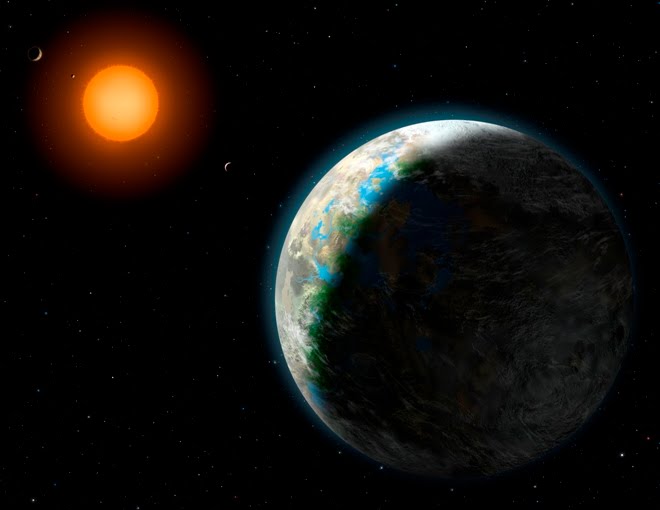
Earth Has A Twin
Solar Powered System

Popular Posts
-
 Russian scientists say chances of Apophis collision with Earth highest in 2036 For those concerned about the effects of Venus during its 201...
 -
 Did Mayans feel 13th pair of Venus Transits would be catastrophic? The next Transit of Venus will occur on June 5–June 6 in 2012, succeeding...
 -
 Potential threat to Earth in the year 2182 When it comes to visiting asteroids, NASA doesn't pick run-of-the-mill space rocks. The targe...
 -
Sustainable Tourism: A Key to Global Solutions by Dr. Reese Halter and Dr. Dave Randle When most people think of tourism, they probably don...
-
 With NASA's announcement of the discovery of rocky planet Kepler 10b, the first thing that came to my mind was "is it habitable?...
Friday, September 16, 2011

Tuesday, September 13, 2011
Are galactic cosmic rays the number one threat to manned spacecraft?
Galactic cosmic rays are one of the most important barriers standing in the way of plans for interplanetary travel by crewed spacecraft.
- Wikipedia, 2011
I am remembering something I read about the two types of space radiation common in our solar system, and how the intensity of this radiation is somewhat predictable using historical data and recent activity. My recall may be faulty, but the premise was something like the expected danger period actually coincided with plans for renewed manned space travel. Now there's the rub ...
Can any readers provide links to articles on this topic? I will do a much longer blogpost when I have some data regarding solar flares and space radiation and the risks to manned space travel. My theory involves promoting the use of robots during the dangerous radiation periods, and resuming human space travel only after the extreme danger fades away.
Any insight into which coming years and decades have the most risk will be greatly appreciated, please post links and info in Comments section below.
from Wikipedia, http://en.wikipedia.org/wiki/Galactic_cosmic_ray ; http://en.wikipedia.org/wiki/Health_threat_from_cosmic_rays
- Wikipedia, 2011
I am remembering something I read about the two types of space radiation common in our solar system, and how the intensity of this radiation is somewhat predictable using historical data and recent activity. My recall may be faulty, but the premise was something like the expected danger period actually coincided with plans for renewed manned space travel. Now there's the rub ...
Can any readers provide links to articles on this topic? I will do a much longer blogpost when I have some data regarding solar flares and space radiation and the risks to manned space travel. My theory involves promoting the use of robots during the dangerous radiation periods, and resuming human space travel only after the extreme danger fades away.
Any insight into which coming years and decades have the most risk will be greatly appreciated, please post links and info in Comments section below.
from Wikipedia, http://en.wikipedia.org/wiki/Galactic_cosmic_ray ; http://en.wikipedia.org/wiki/Health_threat_from_cosmic_rays
Tuesday, August 30, 2011
NASA: Evacuation of Intl Space Station may be required this Autumn
Russian rocket launch failure imperils future missions

November may result in abandoned Space Station
By Marcia Dunn, The Associated Press
CAPE CANAVERAL, Fla. - Astronauts may need to take the unprecedented step of temporarily abandoning the International Space Station if last week's Russian launch accident prevents new crews from flying there this fall.
Until officials figure out what went wrong with Russia's essential Soyuz rockets, there will be no way to launch any more astronauts before the current residents have to leave in mid-November.
The unsettling predicament comes just weeks after NASA's final space shuttle flight.
"We have plenty of options," NASA's space station program manager, Mike Suffredini, assured reporters Monday. "We'll focus on crew safety as we always do."
Abandoning the space station, even for a short period, would be an unpleasant last resort for the world's five space agencies that have spent decades working on the project. Astronauts have been living aboard the space station since 2000, and the goal is to keep it going until 2020.
Suffredini said flight controllers could keep a deserted space station operating indefinitely, as long as all major systems are working properly. The risk to the station goes up, however, if no one is on board to fix equipment breakdowns.
Six astronauts from three countries presently are living on the orbiting complex. Three are due to leave next month; the other three are supposed to check out in mid-November. They can't stay any longer because of spacecraft and landing restrictions.
The Sept. 22 launch of the very next crew — the first to fly in this post-shuttle era — already has been delayed indefinitely. Russia's Soyuz spacecraft have been the sole means of getting full-time station residents up and down for two years. The capsule is parked at the station until they ride it home.
To keep the orbiting outpost with a full staff of six for as long as possible, the one American and two Russians due to return to Earth on Sept. 8 will remain on board at least an extra week.
As for supplies, the space station is well stocked and could go until next summer, Suffredini said. Atlantis dropped off a year's supply of goods just last month on the final space shuttle voyage. The unmanned craft destroyed Wednesday was carrying 3 tons of supplies.
For now, operations are normal in orbit, Suffredini noted, and the additional week on board for half the crew will mean additional science research.
The Soyuz has been extremely reliable over the decades; this was the first failure in 44 Russian supply hauls for the space station. Even with such a good track record, many in and outside NASA were concerned about retiring the space shuttles before a replacement was ready to fly astronauts.
Russian space officials have set up an investigation team and until it comes up with a cause for the accident and a repair plan, the launch and landing schedules remain in question. None of the spacecraft debris has been recovered yet; the wreckage fell into a remote, wooded section of Siberia. The third stage malfunctioned; a sudden loss of pressure apparently was noted between the engine and turbopump.
While a crew may well have survived such an accident because of safety precautions built into the manned version of the rocket, no one wants to take any chances.
One or two unmanned Soyuz launches are on tap for October, one commercial and the other another space station supply run. Those would serve as important test flights before putting humans on board, Suffredini said.
NASA considered vacating the space station before, following the space shuttle Columbia disaster in 2003. Back then, shuttles were still being used to ferry some station residents back and forth. Instead, the station got by with two-man crews for three years because of the significant cutback in supplies.
The space station's population doubled in 2009, to six. It wasn't until the space station was completed this year that science research finally took priority.
Even if the space shuttles still were flying, space station crews still would need Soyuz-launched capsules to serve as lifeboats, Suffredini said. The capsules are certified for no more than 6 1/2 months in space, thus the need to regularly rotate crews. Complicating matters is the need to land the capsules during daylight hours in Kazakhstan, resulting in weeks of blackout periods.
NASA wants American private companies to take over crew hauls, but that's three to five years away at best. Until then, Soyuz capsules are the only means of transporting astronauts to the space station.
Japan and Europe have their own cargo ships and rockets, for unmanned use only. Commercial front-runner Space Exploration Technologies Corp., or SpaceX, plans to launch a space station supply ship from Cape Canaveral at the end of November. That would be put on hold if no one is on board to receive the vessel.
Suffredini said he hasn't had time to consider the PR impact of abandoning the space station, especially coming so soon after the end of the 30-year shuttle program.
"Flying safely is much, much more important than anything else I can think about right this instant," he said. "I'm sure we'll have an opportunity to discuss any political implications if we spend a lot of time on the ground. But you know, we'll just have to deal with them because we're going to do what's safest for the crew and for the space station."
Official NASA.gov Space Station website
Tuesday, August 2, 2011
Comet Elenin, asteroid Vesta each in the news

Dawn took this image over Vesta's northern hemisphere after the spacecraft completed its first passage over the dark side of the giant asteroid on July 23, 2011.
NASA's Dawn spacecraft captures images of "Dark Side of Vesta"
A NASA spacecraft orbiting the huge asteroid Vesta is beaming home images that reveal the giant space rock like never before, showing its battered and pockmarked surface in stunning detail.
The new Vesta photos from the Dawn probe, which NASA unveiled today (Aug. 1), include the spacecraft's first full-frame view of the entire asteroid and should help astronomers understand how the space rock formed in the early solar system, researchers said.
"We could not imagine the detail we're seeing and the processes that we're seeing," said Chris Russell, Dawn's principal investigator at UCLA, during the announcement.
News.Yahoo.com story on Dawn spacecraft and Vesta asteroid photographs
NASA article aboutVesta images and dawn spacecraft, on Space.com
Is comet Elenin actually planet Nibiru?

Comet Elenin FAQs by astronomer Ian Musgrave
Astronomer and blogger Ian Musgrave from South Australia has been active in debunking the misinformation and nonsense that is being disseminated about Comet Elenin. He has written several wonderful posts featuring the actual realities of this long-period lump of dirty ice that has, for some reason, attracted the attention of doomsdayers, 2012ers, and end-of-the-world scaremongers. Earlier this week, Ian’s Elenin posts on his Astroblog were taken down by the web host, as someone filed a claim for alleged violation of the Digital Millennium Copyright Act (DMCA). “Given that there is no copyrighted material on these pages, with either material generated entirely by me or links to and citation of publicly available material, I believe this was just a frivolous attack on people countering Elenin nonsense” Ian said. Astroblog was not the only site that was targeted, and thankfully, Ian’s web host agreed that the claim was without merit, and the posts are back online. In the interim, however, Universe Today offered to publish Ian’s excellent “Comet Elenin, a FAQ for the Worried” post, and even though the original is now available again, Ian and I decided to still post this on UT so that more people with questions about Comet Elenin would have the chance to have their worries allayed. Have your questions answered below.
Will Comet Elenin Hit Earth?
No, its closest approach is 0.23 AU on Oct 16, 2011, where 1 AU is the distance from the Earth to the Sun. To put this in perspective, this is only a little closer than the closest approach of Venus to Earth, and roughly 100 times the distance from the Earth to the Moon. This distance is from the latest MPEC ephemeris which is based on over 100 observations from multiple observatories that have been continuously tracking the comet, so it won’t change appreciably.
Surely if Elenin Was Going to Hit the Earth NASA/the Government Would Hush it Up? Which government? The Australian Government, the UK Government? The Italian Government? The South African Government?
Amateur astronomers world wide are following this comet and continually talking to each other. The have the programs to work out where the comet is going. If the comet was coming anywhere near us, the amateur community would be first to know, and there is no keeping them quite. Consider how wide spread the information is about Apophis, which is a real, if extremely marginal, hazard.
Will it Cause Earthquakes, Abnormally High Tides or Other Disasters?
No, Elenin is a mere 3-5 kilometres across and has less than a billionth of the tidal force of the Moon at closest approach (as well as a negligible magnetic field). If the Moon can’t cause the poles to tip, cause massive tidal floods or earthquakes, Comet 2010 X1 Elenin won’t. We’ve been closer to other comets before with no ill effect.
Full Comet Elenin FAQs by astronomer Ian Musgrave
Space.com article on Planet Nibiru
Wednesday, June 22, 2011
348 days to 2012 Transit of Venus

Did Mayans feel 13th pair of Venus Transits would be catastrophic?
The next Transit of Venus will occur on June 5–June 6 in 2012, succeeding the previous transit on June 8, 2004. After 2012, the next transits of Venus will be in December 2117 and December 2125. Transits of Venus are among the rarest of predictable astronomical phenomena and currently occur in a pattern that repeats every 243 years, with pairs of transits eight years apart separated by long gaps of 121.5 years and 105.5 years.
As there have been 13 pairs of the Transit of Venus since the last major climactic calamity on Earth, that's a cycle of 3,159 years (13 times 243), which takes us back to around 1150BCE.
Wikipedia pins Bronze Age collapse to 1150-1200BCE
The Bronze Age collapse is a transition in southwestern Asia and the Eastern Mediterranean from the Late Bronze Age to the Early Iron Age that some historians believe was violent, sudden and culturally disruptive. The palace economies of the Aegean and Anatolia which characterised the Late Bronze Age were replaced, after a hiatus, by the isolated village cultures of the Ancient Dark Age.
Between 1206 and 1150 BCE, the cultural collapse of the Mycenaean kingdoms, the Hittite Empire in Anatolia and Syria,[1] and the Egyptian Empire in Syria and Canaan interrupted trade routes and severely reduced literacy. In the first phase of this period, almost every city between Troy and Gaza was violently destroyed, and often left unoccupied thereafter: examples include Hattusa, Mycenae, Ugarit.
The gradual end of the Dark Age that ensued saw the rise of settled Neo-Hittite Aramaean kingdoms of the mid-10th century BCE and the Neo-Assyrian Empire.

Wikipedia info on 2012 Transit of Venus
Above Top Secret 2012 Transit of Venus webpage
Tuesday, May 31, 2011
NASA to send space probe to Asteroid 1999 RQ36

Potential threat to Earth in the year 2182
When it comes to visiting asteroids, NASA doesn't pick run-of-the-mill space rocks. The target of NASA's latest asteroid mission is not only thought to be rich in the building blocks of life, it also has a chance — although a remote one — of threatening Earth in the year 2182.
NASA will launch a sample-return mission to an asteroid in 2016, agency officials announced on May 25. The mission will be called Origins-Spectral Interpretation-Resource Identification-Security-Regolith Explorer (OSIRIS-Rex) and will reach an asteroid called 1999 RQ36 in 2020. The unmanned spacecraft will use a robotic arm to snag some samples. According to the plan, the probe will return these bits of space rock to Earth in 2023 so scientists can study them for clues about the solar system's origin and, possibly, how life may have begun on our planet.
The $800 million OSIRIS-Rex will be the United States' first asteroid sample-return effort and only the second mission in history to retrieve samples from an asteroid. Japan's Hayabusa spacecraft successfully returned tiny grains of the asteroid Itokawa to Earth in June 2010.
Related links:
Space.com article on NASA's 2016 mission to Asteroid 199 RQ36
Why NASA Chose Potentially Threatening Asteroid for New Mission
Sources: Space.com, News.Yahoo.com
Monday, May 9, 2011
Yu55 asteroid to pass near earth just before 2012 begins

Flyby within 200,000 miles of Earth, or 1 Light-second
According to Space.com (May 8th, 2011), An asteroid the size of an aircraft carrier will come closer to Earth this autumn than our own moon does, causing scientists to hold their breath as it zooms by. But they'll be nervous with excitement, not with worry about a possible disaster.
There's no danger of an impact when the asteroid 2005 YU55 makes its close flyby Nov. 8, coming within 201,700 miles (325,000 kilometers) of Earth, scientists say.
So they're looking forward to the encounter, which could help them learn more about big space rocks.
"While near-Earth objects of this size have flown within a lunar distance in the past, we did not have the foreknowledge and technology to take advantage of the opportunity," Barbara Wilson, a scientist at NASA's Jet Propulsion Laboratory in Pasadena, Calif., said in a statement. "When it flies past, it should be a great opportunity for science instruments on the ground to get a good look." [Photos: Asteroids in Deep Space]
Getting to know YU55
Asteroid 2005 YU55 is about 1,300 feet (400 meters) wide. It was discovered in December 2005 by the Spacewatch program at the University of Arizona in Tucson.
Because of the asteroid’s size and orbital characteristics, astronomers have flagged 2005 YU55 as potentially dangerous down the road. But the upcoming encounter is no cause for alarm, researchers said.
"YU55 poses no threat of an Earth collision over, at the very least, the next 100 years," said Don Yeomans, manager of NASA's Near-Earth Object Program Office at JPL. "During its closest approach, its gravitational effect on the Earth will be so minuscule as to be immeasurable. It will not affect the tides or anything else."
This round space rock has been in astronomers' cross hairs before. In April 2010, astronomers at the National Science Foundation's Arecibo Observatory in Puerto Rico generated some ghostly radar images of 2005 YU55 when the asteroid was about 1.5 million miles (2.3 million km) from Earth.
But those pictures had a resolution of just 25 feet (7.5 meters) per pixel. The November close pass should provide some sharper images.
"When 2005 YU55 returns this fall, we intend to image it at 4-meter resolution [13 feet] with our recently upgraded equipment at the Deep Space Network at Goldstone, California," said JPL radar astronomer Lance Benner. "Plus, the asteroid will be seven times closer. We're expecting some very detailed radar images."
Space.com article about Yu55 asteroid that will pass close to Earth
Subscribe to:
Posts (Atom)
Search Green Stocks Investing Network

Custom Search